
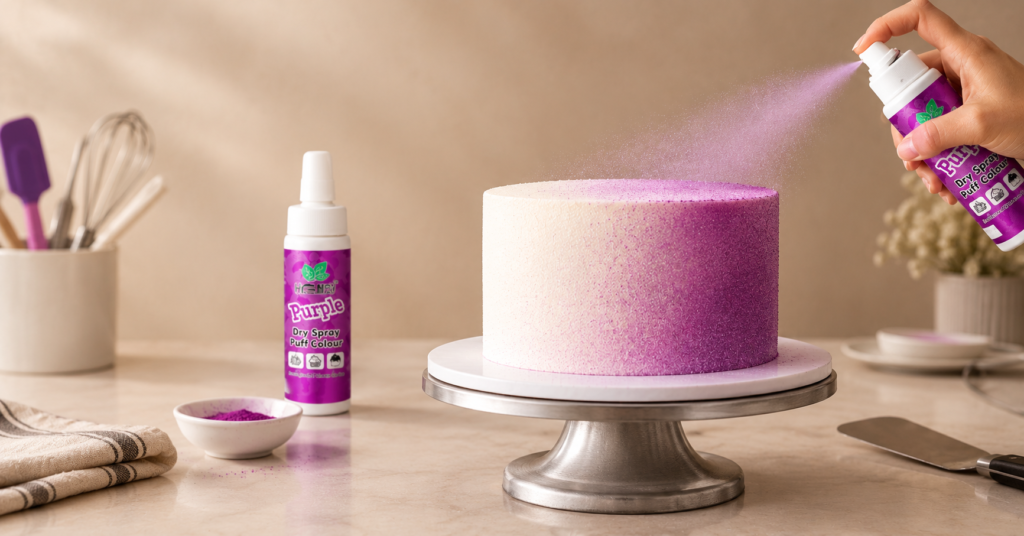
Dry Spray Colour for Cakes: Uses, Benefits and Decoration Applications
Colour plays a role in making the cake appealing even before it has been cut into a slice for consumption. From pastel-colored birthday cakes to vivid celebration-themed cakes, colours are among the components of bakery decoration. Selecting the appropriate colouring format could assist professional bakers in meeting their goals in terms of achieving the desired look of their creations while being practical during the decoration process.
There are different types of colours that can be used for cake, including liquid colour, gel color, powder color, and spray format. Different purposes have been identified for each. The dry spray colour for cakes could be useful for some chosen surface decorations, based on the product formulation and the manufacturer’s recommendation.
Let us find out about dry spray colour, possible uses, and the factors to consider when selecting a cake food colour.
For more follow us on Instagram .
What Is Dry Spray Colour for Cakes?
Dry spray colour is used via the spray method. There can be various kinds of this product, so the purpose of the specific dry spray color should be found out before application.
dry spray colour that can be added to appropriate batter or icing, the spray product can be formulated for decorating purposes. It depends on such factors as cake’s texture, moisture, temperature, and the way of applying.
It is important that the name of the product cannot prove its edibility.

How does dry spray colour work?
A dry spray colour will apply color on a surface in accordance with its instructions. The output will differ on buttercream, fondant, and other decorative mediums.
For instance, a smooth fondant surface might show different results than a buttercream with texture. This is why it’s better to test out on a sample piece first before decorating an entire cake.
Uses of Dry Spray Colour in Cake Decoration
A proper application is determined by the specifications of the product. There dry spray colour are certain scenarios concerning cake decorating in which an appropriate spray colour can be applied.
- Celebration cakes
Celebratory cakes including birthday, anniversary, and theme cakes sometimes need dry spray colour that would fit the design. If an applicable spray product has instructions allowing its use for selected surface decoration, then it can be used.
It should be tested first on a sample made using the same icing or decoration materials as the cake.
- Buttercream decoration
Buttercream is a decorating technique for piping and for giving smooth surface. The consistency and temperature of the buttercream can influence the behaviour of a certain colouring product.
When choosing an edible cake colour for buttercream, ensure that the product is designed for the surface. You cannot assume that a certain spray product will be appropriate for all icings.
- Fondant and decoration elements
Fondant creates a smooth surface and dry spray colour is very popular in various cake designs. An appropriate spray colour can be used for selected fondant decorations.
Benefits of Dry Spray Colour
Appropriate spray colour can be beneficial for certain decoration purposes.
- Another colour form: It presents one more choice to liquid, gel, and powder colours.
- Decoration of surfaces: This choice may be appropriate if there is a need to dry spray colour only a surface and not a full recipe.
- Choice due to design requirements: It can be used in case of certain decoration effects possible with such products.
- Choice due to application method: This choice gives an opportunity for bakers to choose the right form of colour for the surface and result.
- Its efficiency and time needed for this vary with each particular product. Not every spray colour can give the same effect.
Dry Spray Colour vs Other Food Colouring Products
Different food colouring products like are designed for different tasks.
Colour format | Typical use consideration |
Liquid food colour | Often used to colour suitable mixtures |
Gel colour | Often selected for colouring suitable icings and mixtures |
Dry spray colour | Powder format for specified colouring or decorative uses |
Dry spray colour | Spray-style application for selected surfaces |
Luster dust | Often associated with decorative finishes; food-use status must be checked |
If you are colouring cake batter, a liquid or gel colour may be suitable when its directions support that use. For a surface decoration, a spray product may be worth considering if it is designed for that application.
The best choice depends on the desired result, product formulation, and instructions-not simply the colour format.
How to Choose the Right Cake Colouring Product
These are some factors to take into consideration before settling on a particular product for a bakery/confectionery business:
Confirming the intended application. Is the product supposed to be applied directly to foods, for surface decoration or something else?
Checking the instructions. Following the recommended technique and limitations.
Testing the color. Applying the dry spray colour to a sample using the same materials that will be used in the final cake.
Checking the consistency. Recording the type of product, batch number, the technique of application and the result for production.
Checking the documentation. Checking for information about the ingredients, intended application, storage and food usage.
Tip for bakers
Keeping a record of successful color tests. The surface used, product, technique of application and the end result.
Explore Kemry Food Colours and Cake Decoration Products
The Kemry by HSJ product belongs to the range of dry spray colour and decorating materials. The best starting point when researching Kemry food colours and other types of food colouring is what you need them for.
If a product is designed for colouring your mixture, it doesn’t mean you can use it for decorating. If a product is designed for decorating, then using it in a recipe is not recommended.
Explore the KEMRY website and the KEMRY Applications page to learn more about colour and decoration categories for bakery and confectionery applications.