
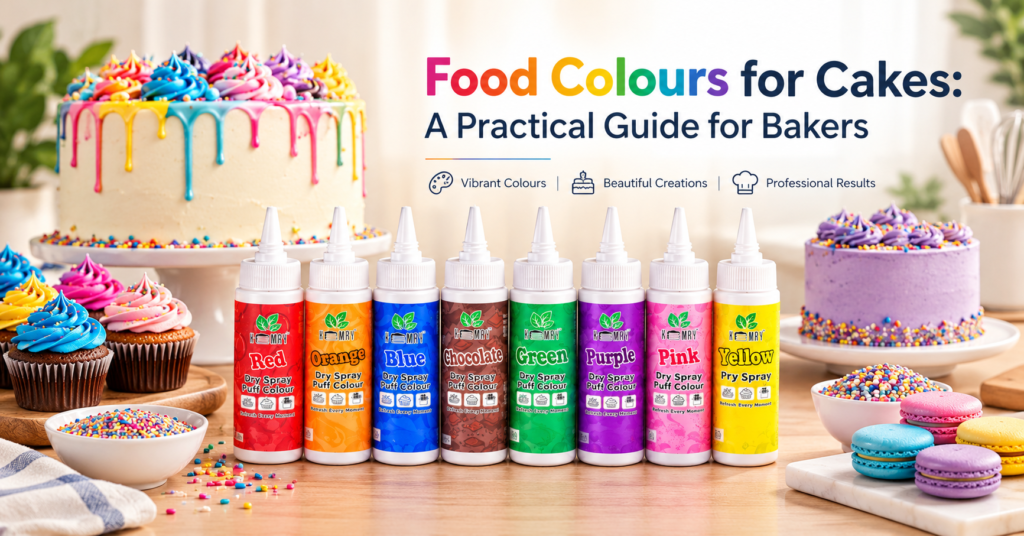
Food Colours for Cakes: A Practical Guide for Bakers and Cake Decorators
A food colours for cakes may be delicious but its looks usually catch people’s attention first. Whether it is a soft pastel birthday cake or vibrant festive cupcakes or a decorated wedding cake – colour adds something special to each bake.
It may be quite easy for a hobbyist to select the proper colour. In case with professionals or bakery, choosing the right colour includes many more aspects because the colour has to fit the batter, be compatible with the decorating medium and give a consistent result.
Which is why knowledge about food colours for cakes can be useful for every baker and decorator on a regular basis.
The types of colouring agents differ from application to application. What may be suitable for the proper cake batter may not be the same for butter cream, chocolate or fondant. The quantity of the product, its components and the baking process itself can play an important role too.
Here we will talk about main types of cake food colour, proper colouring techniques and food safety issues for Indian bakers.

What Are Food Colours for Cakes?
food colours for cakes refer to the coloring agents or preparations that provide a desired cake component with a specified color. Depending on the product, it could be used in cake batter, frosting, icing, fondant, or other applications.
These products come in various forms such as liquids, gels, powders, and oils. The characteristics of each form vary, and the applicability will depend on the product formulation and manufacturers’ directions.
For instance, a cake maker intending to produce a pastel pink sponge needs to use a different method compared to the one intending to make deep red butter cream or coloring a chocolate preparation.
The first step in using these products is to know the desired component, and not the color.
Why do bakers use cake food colour?
food colours for cakes can serve several purposes:
- Creating a theme: Matching a cake to a birthday, wedding, festival or other event.
- Distinguishing flavours: Using different colours to help identify varieties in a display.
- Building visual contrast: Combining coloured layers, frosting and decorative details.
- Supporting product presentation: Giving cakes and cupcakes a consistent appearance.
- Developing signature designs: Helping a bakery create a recognisable style.
Colour should complement the product rather than replace good baking technique. A beautifully coloured cake still needs the right texture, flavour and finish.
Types of Food Colours for Cakes
Not all food colours for cakes products work in the same way. Understanding their formats helps you shortlist products before testing them in a recipe.
1. Liquid food colour
Liquid food colour is supplied in a liquid form and can be useful in suitable recipes where the formulation is compatible with the preparation.
It is often convenient to dispense and mix, but its colouring strength and the amount of liquid it introduces can vary between products.
When should you consider liquid cake food colour?
Consider a liquid format when:
- The product is labelled for your intended application.
- The recipe can accommodate the additional liquid.
- The desired shade can be achieved at the recommended usage level.
- The colour mixes evenly into the preparation.
For example, a baker colouring a suitable cake batter may find a liquid product convenient. However, a concentrated gel or another format may be more appropriate when a recipe requires strong colour without introducing much additional liquid.
Do not assume that all liquid colours have the same concentration. Follow the instructions for the specific product.
How to Choose the Right Colour for Different Cake Components
Food colour for cake batter
Food colour for buttercream and frosting
Food colour for fondant
Food colour for chocolate
Food colour for decorative icing
Exploring KEMRY Food Colouring Products
KEMRY, a brand by KEMRY By HSJ Industries in Rohini, New Delhi, India, offers a range of colouring and confectionery decoration product categories.
For food colours for cakes businesses exploring cake colouring solutions, relevant categories to investigate include liquid food colour, synthetic food colour, dry colour dust and metallic colours.
Each category serves a different potential purpose, and suitability depends on the individual product’s documented intended use.
Before selecting a KEMRY product for cake batter, frosting, fondant or another preparation, review the product information and confirm that the intended application is supported.
A useful starting point is to identify your requirement:
- What food preparation needs colouring?
- What colour and finish do you want?
- What format is compatible with the recipe?
- What product instructions and compliance information are available?
This gives you a clearer basis for discussing your requirements with a supplier.
Explore the KEMRY website for available product information and contact the business to ask about the specifications and intended uses of individual products.
Conclusion:
Choosing food colours for cakes involves more than selecting a shade. The right product must suit the recipe, work with the intended application and meet the relevant food-safety requirements.
Liquid, gel, powder and oil-based colouring products each have different characteristics. Understanding these differences helps bakers make more informed choices for cake batter, frosting, fondant and other preparations.
For professional cake decorators and commercial bakeries, consistency is just as important as appearance. Measuring quantities, testing recipes, recording results and following product instructions can help make colour outcomes more repeatable.
KEMRY offers several food-colouring and confectionery decoration categories for businesses to explore. The next step is to identify your application and confirm the suitability of the relevant product.