
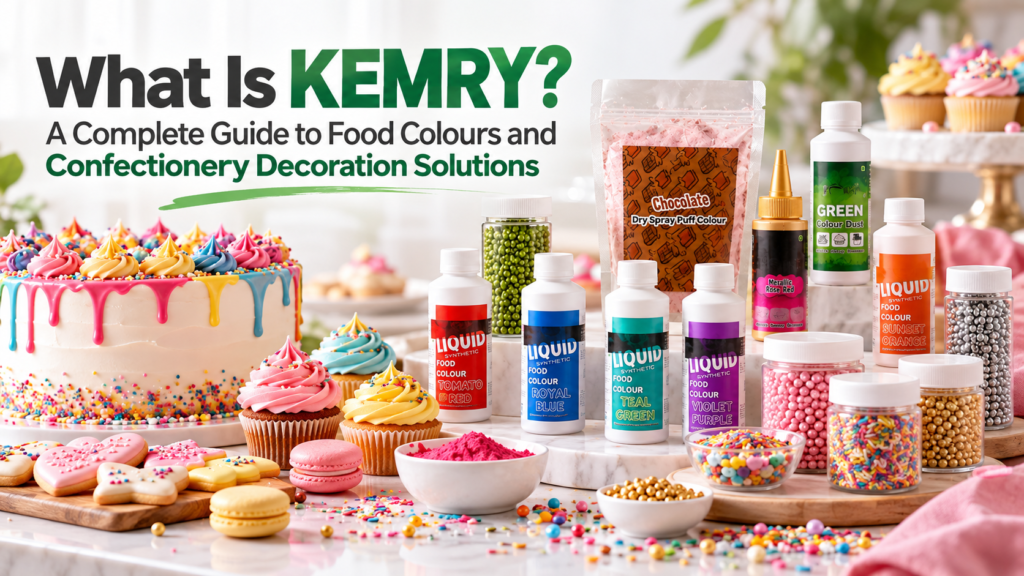
What Is KEMRY? A Complete Guide to Food Colours and Confectionery Decoration
Food is often remembered for how it tastes. The way it looks matters just as much in shaping people’s experience. A cake with an elegant glaze, a chocolate with a shiny metallic coating or a bright colourful candy can catch the eye before a single bite. For food makers -whether they run bakeries, confectionery shops or manufacturing units-colour and decoration are not extras. They are parts of how their products are seen and chosen.
That’s where KEMRY comes in.
KEMRY is a brand from KEMRY By Jinoyal Industries, located in Rohini, New Delhi, India. The brand specializes in confectionery colouring and decoration materials for businesses and individuals who want to improve the appeal of their food items. From bakers, to large-scale producers KEMRY offers tools to make food look better, more exciting and more tempting.
For more Follow on Instagram
What Is KEMRY?
KEMRY is a confectionery colouring and decoration brand that belongs to Kemry By Jinoyal Industries in Rohini, New Delhi, India.
KEMRY focuses on giving a range of colouring and decorative materials to businesses that work with confectionery and related food products. KEMRY materials serve presentation needs from adding colour to food preparations to creating decorative details and visual effects.
Who can explore KEMRY products?
KEMRY’s range may be relevant to businesses such as:
- bakeries and cake manufacturers.
- Chocolate and confectionery manufacturers.
- manufacturers.
- Biscuit and cookie producers.
- Dessert and frozen dessert businesses.
- Food product developers.
- Professional confectionery decorators.
- Distributors and businesses sourcing decoration materials.
What is confectionery decoration?
Confectionery decoration means adding details to cakes, chocolates, sweets and other suitable desserts.
Depending on the product and its intended use confectionery decoration may include:
- accents.
- Surface finishes.
- Decorative particles.
- Sprinkles and shaped elements.
- Contrasting colours and textures.
- Patterned or themed designs.
The choice of material affects the look, the way it is applied and the production process.
Manufacturers should therefore check how confectionery decoration will perform on the product rather than choosing it just because of its name or colour.
KEMRY Product Range: A Category-by-Category Guide
Understanding the categories is a useful first step when selecting food colouring products and confectionery decoration materials.
- KEMRY Luster Dust
Luster dust is a colour product commonly linked to decorative finishes in confectionery.
Depending on its mix and intended use a luster‑dust product may be made to give a surface look. The name alone does not say if the product is edible, safe for food use or approved for a specific purpose.
- KEMRY Liquid Food Colour
Liquid food colour is a colour category sold in form. Liquid products can be handy when the process needs a colourant that can be measured and added to a mix. Possible uses depend on the mix and the food type for which the colour is allowed.
- KEMRY Synthetic Food Colour
Synthetic food colours are made by synthesis. Are used only in food where the colour and its use are allowed. Their fit depends on the dye, the food limits that apply and the product’s documents.
Where can synthetic food colours be useful?
Businesses may look at this category when making coloured foods or products that need a set colour. However a synthetic food colour is not automatically allowed for every food. In India firms should check the Food Safety and Standards Authority of India (FSSAI) rules and the product’s paperwork before use.
Useful checks include:
– The dye’s identity.
– The food types it can be used in.
– The maximum level, if set.
– Required labelling and declarations.
– The maker’s instructions.
For companies buying colour in bulk these checks should be part of supplier and product review.
- KEMRY Metallic Colours
Metallic colours give a metallic-style look. They may interest makers who want a finish. The word “metallic” only tells the intended look; it does not reveal the mix, safety or allowed use of a product.
Potential areas to explore:
If the product’s specs are verified a business might look at colour products for:
– Selected chocolate decorations.
– Confectionery details.
– Cake decorations.
– Special-occasion designs.
- KEMRY Dry Colour Dust
Dry colour dust is a category of dust-style colour material. Different products in this group can have mixes how they are. What they are meant for. Its style may suit firms that prefer a product, for a manufacturing or decoration job.
What should firms check?
Before picking a colour product examine:
– Its use.
– Whether direct food use is allowed.
– The recommended way to apply it.
– How it works with the target surface.
– Any special handling or storage notes.
- KEMRY Dry Spray Colour
Dry spray colour is a category in the KEMRY product line. The spray format can matter when a manufacturer or decorator wants a way to apply the colour.
The exact result depends on the product mix and the instructions. Some spray-format products may aim to give a finish that’s different from other dry colour categories so the description should clearly show that difference.
- KEMRY Decorative Sprinkles
Decorative sprinkles are pieces used to add colour, texture or visual detail to suitable food products.
Potential applications
Depending on the mix and intended use decorative sprinkles may be used for:
- Cakes and cupcakes.
- Doughnuts.
- Biscuits.
- Dessert toppings.
Selected confectionery products.
For example a bakery making a colourful cupcake range may compare sprinkle shapes and colours to match its product design.
The final choice should look at more than appearance. Particle size, handling, surface compatibility and how the finished product will be stored may also matter.
- KEMRY Sugar Balls
Sugar balls are ball-shaped confectionery elements. They can add a shape and visual contrast to suitable products.
Their size, colour, mix and intended use determine where they may be suitable.
Where might sugar balls be considered?
Potential applications include:
- Cake and cupcake decoration.
- Selected confectionery designs.
- Dessert decoration.
- Suitable sweet and bakery products.
A manufacturer should check whether the decorative elements fit the target product and the consumer experience. Size and texture for example may be important when deciding how a decorative ingredient fits into a product.
- KEMRY Metallic CON-Fusion Mixtures
Metallic CON-Fusion Mixtures is a named category in the KEMRY product portfolio.
Because a category name alone does not explain the products mix or intended use the product page should give information about its characteristics, how to use it and technical details.
Businesses looking at this category should confirm:
- The mix and product format.
- The intended use.
- Whether the product is suitable for food use.
- The appearance it is designed to create.
- Any usage restrictions that apply.
This information helps professional buyers see the difference, between a products positioning and its real technical capabilities.
- KEMRY Vermicelli
In confectionery vermicelli usually means strand-shaped decorative elements. In a product range buyers should check the product mix and intended use instead of assuming all vermicelli are the same.
Potential application areas
Depending on the product specifications decorative vermicelli may be used for:
Cakes and cupcakes.
- Selected sweet products.
- Dessert toppings.
- Other suitable confectionery preparations.
Its strand shape gives a decorative look compared to round sugar balls or small sprinkle pieces.
For manufacturers the choice should be based on the products design how it must be handled and its intended use.
KEMRY, which is part of KEMRY By Jinoyal Industries in Rohini, New Delhi has a range of products that include dry colors, metallic-style colors and decorations like sprinkles, sugar balls and vermicelli.